
 0
0



- Hogar
- Blog
- Guía de negocios de extensiones de cabello
- Hair Vendors Explained: What Really Matters Beyond the Price Tag
Hair Vendors Explained: What Really Matters Beyond the Price Tag

In an increasingly competitive hair industry, choosing hair vendors is about more than just comparing prices. Whether a supplier can consistently provide uniform quality, deliver on time, and maintain good communication throughout the partnership will all impact product sales performance and brand image. Many businesses tend to focus on initial quotes while ignoring the extra costs brought by inconsistent quality, return processing, and delivery delays. Shiny Hair will guide you through the key points of selecting hair vendors, helping you evaluate quality, supply capacity, and cooperation terms to find a supply partner better suited for long-term development.
〈Related Articles: Hair Extension Vendors Guide: Hot Styles, Supplier Comparison & Common Mistakes to Avoid〉
Why Choosing the Right Hair Vendors Matters
Choosing the right hair vendors affects more than just single-purchase costs; it directly impacts subsequent sales and brand reputation. Stable suppliers can control everything from hair sourcing and production processes to quality inspections, reducing issues like shedding, tangling, color differences, or inconsistent workmanship.
For retailers, hair salons, and cross-border sellers, stable supply means being able to arrange inventory and sales plans with greater peace of mind. Conversely, if product quality fluctuates frequently, it not only increases the cost of handling returns but may also affect consumer trust in the brand. Taking Shiny Hair as an example, every production detail from raw material selection to sample testing is strictly controlled, providing partners with more security in product quality and supply arrangements.
〈Related Articles: How to Choose a Hair Extension Supplier? A Guide for Hair Quality, Supply, and After-Sales Details〉
Key Standards of Reliable Hair Vendors
When choosing hair vendors, price is certainly an important consideration, but you cannot look at the quote alone. You need to evaluate from aspects such as raw material quality, production capacity, cooperation flexibility, and after-sales service. A hair vendor worthy of long-term cooperation usually possesses the following key conditions:
- High-Quality Hair Sourcing: Premium suppliers strictly control hair sources, guaranteeing 100% human hair, avoiding the mixing of animal hair or chemical fibers, and ensuring cuticles are aligned in the same direction to prevent tangling and frizzing during wear.
- Clear Pricing Structure: Providing reasonable factory prices and clearly explaining product costs, processing fees, and related service fees to avoid unknown extra charges later.
- Flexible Order Quantities: Being able to provide lower minimum order quantities (MOQ) for startup sellers to reduce financial pressure.
- Strong QC & After-Sales Support: Having a comprehensive return and exchange policy and a strict quality inspection process before leaving the factory.
〈Related Articles: Remy Human Hair Extensions: The Secret Behind Smooth, Long-Lasting Hair〉
Why Hair Vendors Outperform Middlemen
| Hair Vendors | Trading Middlemen / Resellers | |
|---|---|---|
| Price | Factory-direct, better margins | Higher cost due to markups |
| Quality | Full control, stable quality | Mixed sources, inconsistent |
| MOQ | Flexible, small trials allowed | Usually high MOQ required |
| Customization | Full customization available | Limited to existing stock |
How to Find and Vet Hair Vendors Effectively
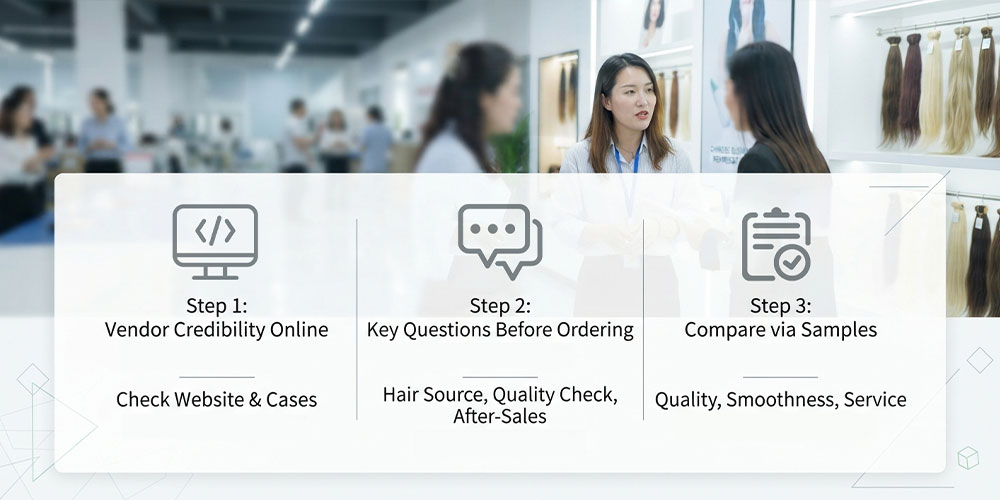
With so many hair vendors in the market, how can you quickly determine if they have stable supply capacity and reliable quality? By mastering a few key screening steps, you can significantly reduce the risk of making a bad choice.
Step 1: Check Vendor Credibility Online
Before contacting hair vendors, you can gain a preliminary understanding by reviewing their official website to check for complete product information and clear categorization. Additionally, you can ask whether they provide actual product photos, past cooperation cases, samples, or factory-related data to further confirm whether the other party possesses stable production and supply capabilities, rather than just being an intermediary reseller.
Step 2: Evaluate Key Questions Before Ordering
Before officially placing an order, it is recommended to communicate several important details with the supplier, including the hair source used, processing flow, quality inspection methods, production time, and after-sales handling. A trustworthy supplier can usually provide clear explanations regarding product details and is willing to assist in sending samples for testing. Compared to sellers who only emphasize low prices, suppliers who value quality and communication efficiency are more worth considering.
Step 3: Compare Vendors Through Sample Testing
After initially screening a few hair vendors, it is recommended not to rush into large orders, but rather to confirm the actual quality through samples first. During testing, you can observe the hair's smoothness, natural luster, shedding level, and stable performance after dyeing. At the same time, you can also understand whether future cooperation will be smooth from the supplier's response speed, communication style, and handling attitude. By comparing different samples and service details, you can then select the supplier that best meets your needs for bulk purchasing.
Common Pitfalls When Choosing Hair Vendors
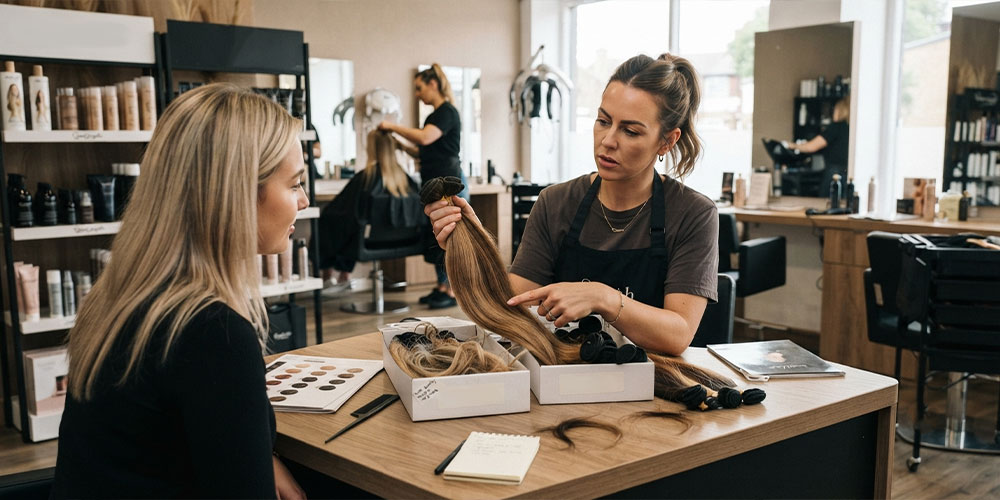
When choosing hair vendors, in addition to focusing on price and product variety, some problems are not easily detectable in the early stages but may affect subsequent quality, delivery time, and cooperation stability.
Unrealistically Low Prices
High-quality human hair raw materials have a certain inherent cost, and it is unlikely they can be offered long-term at prices far below market rates. If some hair vendors provide quotes significantly lower than the market average, it is recommended to first confirm the product material and production method. Some low-priced products may be mixed with synthetic hair or use lower-quality non-Remy hair, which may seem to save costs in the short term but are prone to tangling, frizzing, or a shortened lifespan later.
〈Related Articles: Why Human Hair Extensions Vary So Much: Key Quality & Supply Issues Buyers Miss〉
Sample–Bulk Quality Gap
Some suppliers will specifically select high-quality products when providing samples, but after a formal bulk order, the goods received differ from the samples. To avoid this situation, quality standards such as hair quality, length, density, and production specifications should be confirmed with the supplier before cooperation, and the responsibilities of both parties should be clearly stated in the contract to ensure consistent quality is maintained during mass production.
Stock & Delivery Risk
Some hair vendors do not have stable inventory or fixed production arrangements but instead look for sources temporarily after receiving orders. This model easily causes unstable delivery and even affects subsequent sales planning. Therefore, before cooperating, you should understand the supplier's production capacity, stocking status and average lead time to confirm whether they can provide a long-term stable supply.
Unclear Return & Refund Policies
After-sales regulations are also an aspect that cannot be ignored when choosing a supplier. If the method for identifying defective products, return and exchange conditions, and processing flow are not confirmed in advance, communication gaps are likely to occur when product problems are encountered. A clear after-sales policy can not only protect the rights and interests of both buyers and sellers but also make subsequent cooperation smoother.
How to Build Long-Term Partnerships with Hair Vendors
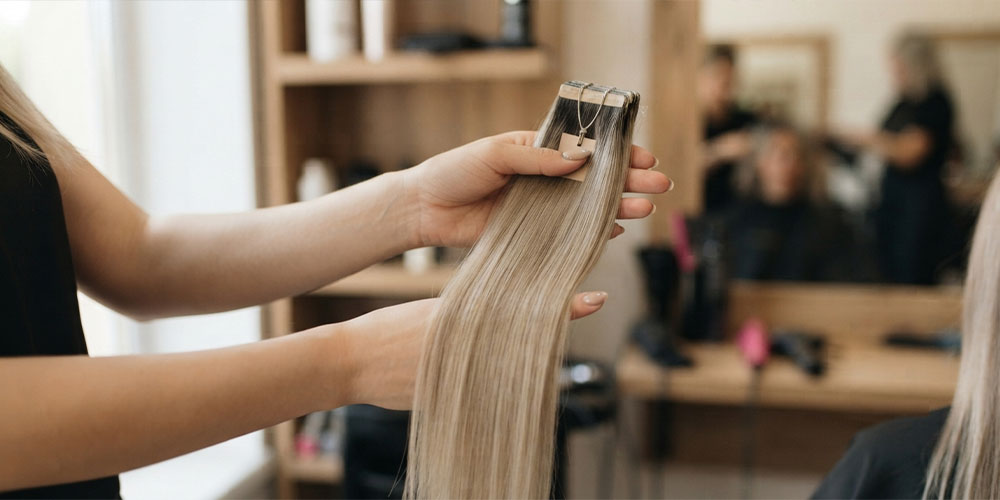
To establish a stable relationship with hair vendors, beyond price considerations, it is more important to build a cooperation model that both parties can maintain for the long term. In the early stages of cooperation, it is recommended to first confirm product specifications, quality requirements, and inspection processes, so that both parties have a consistent understanding of product standards and deliverables, reducing subsequent communication gaps.
Once cooperation is stable, maintaining fixed procurement arrangements and smooth communication allows suppliers to better manage production schedules and inventory needs, reducing lead time instability. For buyers looking for long-term operations, in addition to providing steady orders, they can also encourage suppliers to invest more resources and jointly maintain a good partnership through reasonable cooperation terms and discussions on new products.
〈Related Articles: What You Must Know Before Working with Wholesale Hair Suppliers: Pricing, Quality & Buying Tips〉
Conclusion
When choosing the right hair vendors, one cannot look at a single factor alone; instead, a comprehensive evaluation is needed, ranging from hair material sourcing and quality grades to the production stability of the factory. Reliable suppliers not only provide human hair products that meet requirements but also assist buyers in maintaining a stable supply during long-term cooperation, reducing uncertainty in operations. Shiny Hair has always insisted on controlling quality from the source, strictly selecting human hair materials, and pairing them with a stable and mature production system to provide partners with reliable products and supply chain support. If you are looking for hair vendors worthy of long-term cooperation, please contact us.

Cabello brillante
Shiny Hair comparte su experiencia directamente desde la fábrica. Con más de 20 años de trayectoria en la selección de cabello en bruto y la fabricación de extensiones de cabello de primera calidad, nos dedicamos a brindar información valiosa sobre la industria y orientación práctica a los profesionales de la belleza en todo el mundo.

Clasificación de artículos
Artículos recientes
- Hair Vendors Explained: What Really Matters Beyond the Price Tag
- Lo que debes saber antes de trabajar con proveedores mayoristas de cabello: precios, calidad y consejos de compra.
- Guía de proveedores de extensiones de cabello: Estilos de moda, comparación de proveedores y errores comunes que debes evitar.
- ¿Dónde comprar extensiones de cabello con trama de mariposa?
- Cómo iniciar un negocio de peluquería